What happened
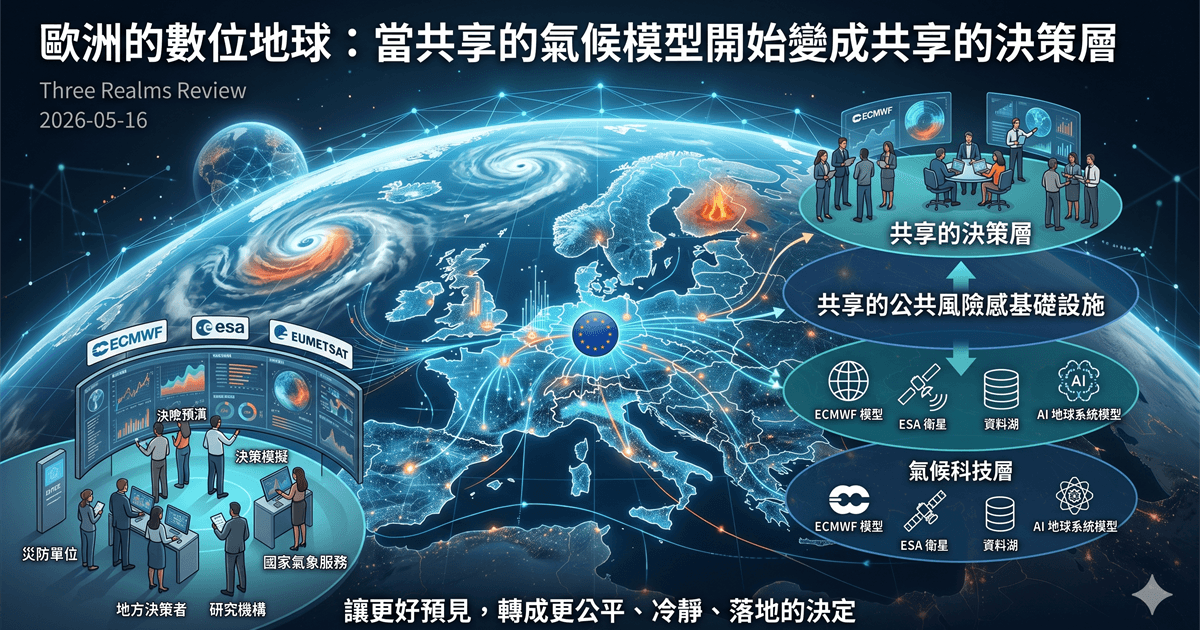
The European Union's Destination Earth initiative — known as DestinE — is moving into its third implementation phase in mid-2026. ECMWF, ESA, and EUMETSAT continue to share the work under European Commission leadership. The technical system includes digital twins of climate adaptation and weather-induced extremes, a digital twin engine, a data lake, and a service platform. Programme pages disagree on whether the next phase begins in June or July 2026, so this article describes the timing as mid-2026.
That is the news. What we want to mark sits underneath it.
Underneath the climate-tech surface
Destination Earth is usually described as a digital twin of Earth. That framing is accurate but small. It makes the project sound like a more powerful weather app or a more ambitious climate model.
The more interesting layer is that DestinE is being positioned as shared decision infrastructure for a set of European institutions. Public materials frame it as useful for national meteorological services, civil-protection agencies, researchers, and local authorities that need to plan against climate-related futures. That is the ambition worth watching: not just a shared dataset, but a shared screen for what future risk could look like.
When several institutions begin reading risk through the same model, that model becomes part of how they decide. This is not a metaphor. It is what happens when forecasting moves from research into operational use.
The layer we are pointing at
The layer to watch is shared risk perception becoming public infrastructure.
Two common readings mark the edges of that field.
One edge is the specialist reading: DestinE as climate technology. That reading is accurate as far as it goes. It describes the models, data lake, digital twin engine, and service platform. The layer it leaves thin is institutional: the technology is being deliberately built as public infrastructure, with Phase Three focused on wider access and operational use.
The other edge is the political-grand reading: DestinE as a quiet step toward a "United States of Europe." That reading notices something real about shared cognition, then moves faster than the evidence. A common model of risk can make coordination easier; budgets, law, legitimacy, and political courage still have to be built elsewhere.
Between those edges sits the article's actual claim: a shared infrastructure for thinking about future risk is being assembled. Whether it changes how Europe decides will depend on how institutions, publics, and local governments choose to use it.
What we are reading
This piece argues that DestinE matters as an early test of whether shared cognition can quietly precede shared coordination.
The claim is narrower than prediction: this is the layer worth watching.
If, in five years, European disaster planning, climate budgeting, and adaptation policy increasingly route through the same simulated reference, that will be a structural fact, not a slogan. If, in five years, the system remains a specialist tool used mostly by climate researchers, that will also be a fact — and the political reading should retract accordingly.
The desk's posture is to keep the question open.
What remains uncertain
- Official programme pages disagree on the exact start month — June versus July 2026.
- Public materials describe intended capabilities. Actual influence on decisions remains unproven.
- How accessible the system will be outside specialist institutions is unclear.
- How local authorities will translate high-resolution simulations into budgets, rules, and emergency plans is also unclear.
- A digital twin is not a neutral mirror of Earth. It is built from data choices, model assumptions, funding structures, and institutional purposes. Treating it as objective is itself a category error to watch for.
Source notes
- ECMWF and the Destination Earth programme confirm Phase Three's direction toward operational use, AI-ready datasets, and AI Earth-system modelling.
- The European Commission's policy page describes DestinE as a flagship initiative for a high-accuracy digital model of Earth.
- EUMETSAT confirms its continued role in strengthening the Data Lake.
- ESA's framing emphasises growing the user community and supporting real climate-related decisions.
Our claim, bounded
The claim is bounded: DestinE is becoming shared public infrastructure for risk perception, and that may matter for how European institutions coordinate under climate pressure.
This article leaves the larger outcomes open. European consolidation, climate destiny, and technological salvation are outside the claim. The piece also treats the project as more than a curiosity for tech-policy readers because public risk perception is part of public decision-making.
What is actually happening is that a piece of public infrastructure for shared risk perception is being built in slow motion. That is worth watching with calm attention.
A model can help a society prepare. It cannot care on a society's behalf. The work of turning better foresight into fairer, calmer, more grounded decisions remains human work.